Saturday, 6 March 2021

St Giles Horspath


As I happened to be near this place on Wednesday I thought I might as well stop off and get a few photos of the church  not really caring if it was against our lockdown rules at the end of the day I was exercising by walking around the church. St Giles was not on my list though I had been looking at a few in the vicinity to visit. There is quite a bit of history to the church and after seeing the photos taken inside the church it will be high on my revisit list Wikipedia history below :- 

"The Church of England parish church of Saint Giles seems to have been built late in the 12th century. The Early English Gothic south aisle, including the south door and three and a half bay south arcade date from this period. From this time the east wall of the chancel had a trio of three stepped lancet windows. The early Decorated Gothic south transept was added late in the 13th or early in the 14th century as a chantry chapel. The south porch was added late in the 14th century.

Around 1400 the present west tower and tower arch were built. The tower arch features two unusual almost life-size sculptures of human figures: one playing the bagpipes and the other showing an expression of amazement. Also in the 15th century the pitch of the nave roof was greatly reduced in typical Perpendicular Gothic style. Late in the 15th century, Perpendicular Gothic windows were inserted in both sides of the chancel and the north wall of the nave. The Perpendicular Gothic piscinae in the chancel and south transept are also 15th century.

In the 18th century Magdalen College, Oxford and the Earl of Abingdon contributed to the building of a west gallery in the nave. By 1840 the east wall of the chancel was out of alignment so the chancel was demolished and rebuilt to designs by the architect HJ Underwood, who retained the Perpendicular Gothic side windows with their mediaeval stained glass but dispensed with the mediaeval roof and replaced the Early English east windows with a neo-Perpendicular one. A contemporary condemned this work as "wanton destruction".

By 1849 the nave was dilapidated so in 1852 the clerestory and west gallery were removed, the north wall was rebuilt and the north transept was added. Once again Underwood was the architect. The work cost £800, of which Baker Morrell of the local Morrell brewing family and Magdalen College each paid £200. The church is a Grade II* listed building.

By 1554 St. Giles' had three bells and by the 18th century it had five. It now has a ring of six bells plus a Sanctus bell. Of the current ring, the oldest is the fourth bell, which Joseph Carter of Reading, Berkshire cast in 1602. William Yare, also of Reading, cast the tenor bell in 1611. Abraham Rudhall of Gloucester cast the second and third bells in 1718. W&J Taylor of Loughborough, who from 1821 to 1854 had a bell-foundry in Oxford, cast the fifth bell in 1838. Mears and Stainbank of the Whitechapel Bell Foundry cast the treble bell in 1866. James Wells of Aldbourne, Wiltshire cast the Sanctus bell in 1811.

St Giles' has a disused turret clock without a dial, the frame of which appears to be late 17th century.

St Giles' has an Elizabethan silver chalice made in about 1569, a carved late Jacobean pulpit, and a number of monumental plaques. One of these, to James Salisbury of Bullingdon Green (who died in 1770), is elaborately decorated. Another is to the five children of Thomas and Esther Herbert, who died from a recurrence of the bubonic plague between 1686 and 1688. Esther, whose family founded New College, also died in 1688 aged 33. A ceramic statuette of Saint Giles made by a local potter in 1988 is in the south chapel.

In 1451 the Crown granted the advowson to the Hospital of St John the Baptist outside the East Gate, Oxford. In 1456 the hospital was suppressed, and all its property granted to Magdalen College, Oxford, newly founded by William Waynflete. From then until 1950 the vicar of St Giles was always a member of the college. George Wilkynson, who was incumbent from 1483, was Dean of Divinity of the University of Oxford.

Many vicars of St Giles were distinguished fellows of the College, but some of the post-Reformation ones neglected the parish. Richard Byfield, who was incumbent from 1666, was a scholar of Hebrew. Baptist Levinz, who was incumbent 1680–82, became Bishop of Sodor and Man in 1685. George Horne, who was incumbent 1760–64, became Vice-Chancellor of the University of Oxford in 1776 and Bishop of Norwich in 1790. Edward Ellerton, who was incumbent from 1814, founded Horspath parish school and left land in the parish to fund scholarships to Magdalen College, Oxford. Frederick Bulley, who was incumbent 1843–49, became President of Magdalen College in 1855. Henry Bramley, who was incumbent 1861–69, was a hymnologist who worked with the composer Sir John Stainer."
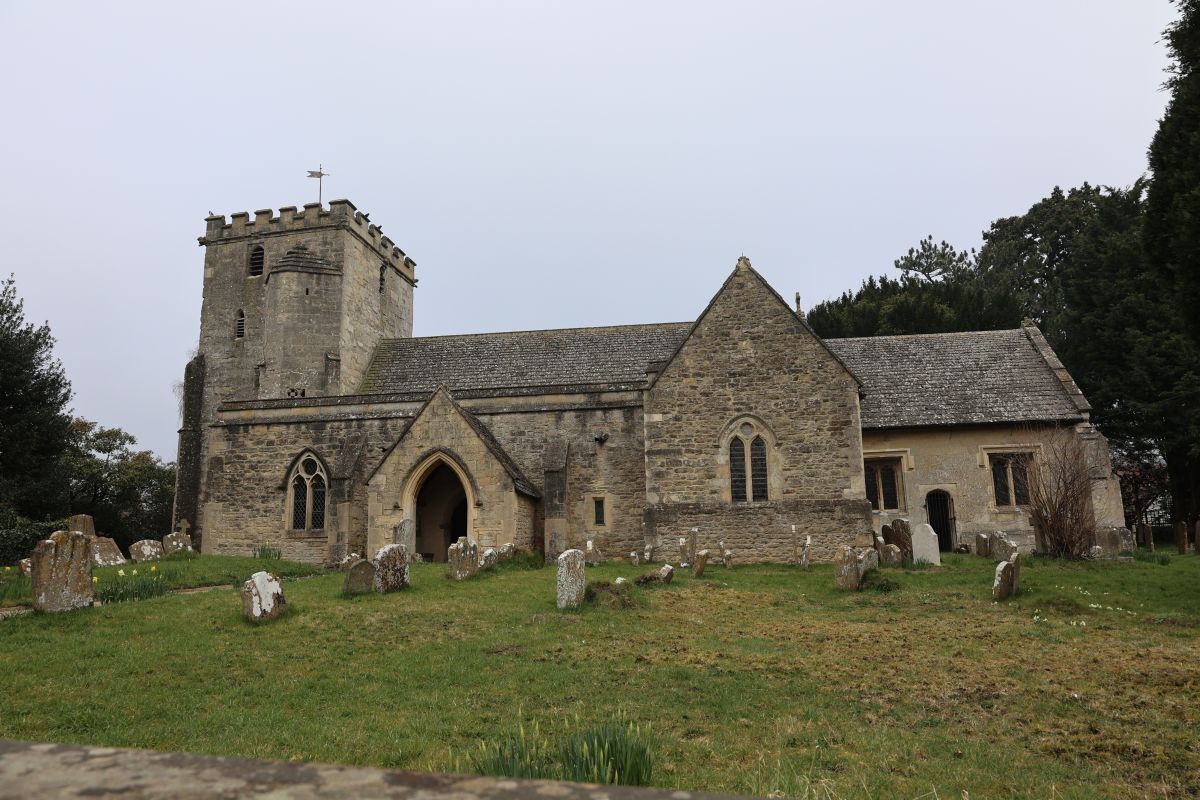
 

St Giles church from over the wall near where I parked


Walk through the south gate the path takes you to the porch


Look west and the belltower dominates your view 
 

 To the east you will find a small transept
 

 Walking around the tower you find a door in the base the stonework around it very eroded apart from some restored stone
 

On a nearby buttress I spotted this circle that looks suspiciously like it may have been a mass dial  
 

 Going further along the path will bring you a view of the north side and an larger transept 
 

Walk along further towards the east and you will get look at the east end of the church
 

A little further and you can make out both transepts 
 

 Further around and you come to the path from the east 
 

From the south path the churchyard shows some of the old graves
 

 With a few more over on the other side
 

 There are more around the north side
 

 Follow the path further brings you to the more recent part of the churchyard
 

 Some look old but I think just weather beaten
 

From a corner you get this view looking towards the south
 

Going back to the south passing the east end you pass more older graves 
 

  A priest door in the chancel is gated with a sturdy steel gate 
 

In the corner of the transept and east end older headstones are packed in
 

A last look of the church before I get in the car and go home. The visit has make me put St Giles high on my list for a revisit when  the importunity arises 
Till next time take care and have a wonderful weekend


Thursday, 25 February 2021

Church Memorials


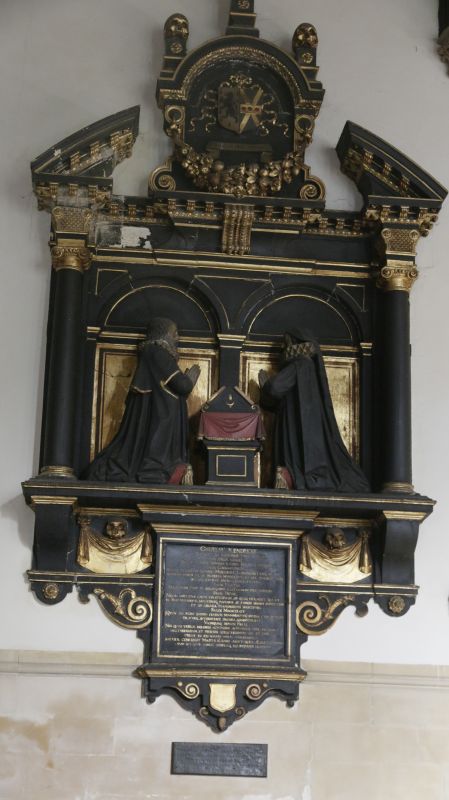
This week I thought I would show you something different. Most churches I visit have a memorial on the walls to one person or another. Many have multiple memorials to different members of the family. Some of the stained glass windows I showed last week were placed there in memory of a loved one, other elaborate ones which are placed on the walls like mini effigies and a lot of them are very old indeed. I  will show some of the more impressive ones I have seen in the churches.

St John in Burford Oxfordshire has a few impressive memorials but this one I liked for the reason it was to Edmund Harman who was Barber & Personal Servant to King Henry VIII now that is a job I do not envy him of doing

has a very elaborate  memorial to the Stone Family taking up the whole East wall of a chapel 

This impressive memorial is across the river from where I live in a village called South Stoke at St Andrews Church belongs to a Griffeth Higgs who passed away in 1659 and is buried in the Chancel

Now we go to Wales and Old Radnor Church where in the South Aisle you will find this memorial to Thomas Lewis 

Next we go to St Peter Little Wittenham beside the River Thames in Oxfordshire where we will find this memorial to Sir William & Lady Dunche Sir William  was Married to Mary who was the Daughter of Oliver Cromwell's grandfather. Cromwell himself travelled to the wedding in the church. A relation of Sir William was Deblorah Moodyfounded Gravesend Brooklyn. I might add you will find memorials to the Dunche Family all over Berkshire & Oxfordshire.


This simple one at All Saints Sutton Courtenay  is one many of you should recognise, mind you his grave is not so easy to find it is so simple like the memorial


 Go to Uffington St Mary's Church for this memorial to John Saunders 


This memorial can be seen at Reading Minster though I did not find out who it belonged to


I'm going to finish with a couple from St Andrews Tichbourne Where you can see this very impressive memorial to   Sir Benjamin Tichbourne and his wife Ammphyllis I might add I see his first wife came from Mapledurham a few miles from where I live.

Very near to the Tichbourne memorial you can see this one above to Richard Tichbourne who lived 18 months and died in 1619


Monday, 15 February 2021

St Peter Didcot


 After looking in my archive of photos I realised I had some photos of a redundant church I visted in Didcot some years ago so This week we visit St Peter Didcot, which is no longer a church but now Northbourne Community Centre. The Church was dedicated in 1890 as the Church of England parish church of St Peter; de-consecrated in 1977 and subsequently converted into a community centre


 From the car park you get a view good view of the church it looks older than it is. I dare say the church was built for the benefit of the railway worked that would have lived in the nearby houses. The carpark may have been built on the old churchyard
View of the bell tower an porch

You need to go out on the road to get a view of the East end of the church

 
This looks along the North side with what was most likely the vestry in the near photo
 
The porch no doubt built at the same time as the church

The East end with vestry

This was stitched to show the whole North side.

 I have been in the building to attend the local historical society meeting a few years ago and got the next couple of photos off the Northbourne Community Centre Facebook page, it shows a view of the church as it is now, the chancel is now a stage area.

This looks back to wards a mezzanine floor which has been constructed over a kitchen area in the bell tower 

Till Next time Take Care have a peaceful weekend


Saturday, 13 February 2021

Church Stained Glass


After mentioning that I would be struggling to  give you a blog on a church I visited through Lockdown one blogger mentions I could do a feature on Stained  Glass. Well most of the churches I visit have stained glass in them some more elaborate than others, some only have one window that is stained others older glass than you would expect. My biggest problem with writing this blog is that there are so many beautiful stained glass windows it is hard to now when ones to show so I will show some of the windows that stood out for me.

This one I can tell you is at St Mary Ipsden not many miles from where I live, it's not out of the ordinary but I love the way the window reflects on the wall  

In the next Village which is again only a few miles from me is All Saints North Morton The church does have some beautiful stained glass but the one which stands out is this magnificent one in the South aisle which has 14th century stained glass in it, I should go back and get some close ups of the glass sometime.

The next place I will show is the Holy Trinity Headington , the East window is quite nice to view but go along the North aisle


You will see this frosted glass window called the  Narnia window in memory of C.S. Lewis who is buried in the churchyard


You need to go to The Holy Trinity Ardington for a really beautiful example of  window frosting, the church is also worth visiting for the beautiful way it is decorated.


Another church with 14th century glass is St Mary Childrey not only that you will be treated to viewing one of the few Norman Lead fonts in Oxfordshire

St Mary Henley on Thames has a lot of stained glass to look at but go in  St Leonard's Chapel you will find three stained glass windows that look similar. You will notice some of it looks older that other parts, don't be fooled from what the vicar told me it is all Victorian

The Vyne is a National Trust property which dates back to before Tudor times, in the house you can be treated to seeing Tudor Stained Glass  

Go in the chapel and you will be treated to the Stained Glass windows the Henry VIII would have seen on his visits there 

Charlecote is another House with some interesting old stained glass in the windows but to me it is surpassed by what you see in the church

In the West end of St Leonard's Church which is now looked after by the Churches Conservation Trust you can see this magnificent Rose Window 


 Not all the stained glass I have seen in old there are some really beautiful modern creations like this one at King's Sombourne dedicated to Tommy Sopwith 
 

All Saints Farnborough  is another church where you can find a superb modern stained glass window which is called the Sir John Betjeman Window, he lived in the old vicarage next door for a time an is remembered with this window that I am told is stunning in the evening sunset.

The next window a smaller stained glass window that was reflecting light on the pews when I walked in. The stained glass is by John Piper and Patrick Reyntiens, who also has his work featured in another Local Church.

At St Bartholomew Nettlebed  You can also see windows in Memory of the Fleming Family 

St Nicholas Newbury like Henley on Thames has an amazing amount of stained glass to view like this huge East window. Much of it has a note beside it telling you what it contains


St Mary Iffey Is where I will finish this blog because not only will you be treated to the best example of Norman Architecture in the UK but you will find both modern and old stained Glass windows and another example of John Pipers work 


but you will also see this stunning round window surrounded by Norman Carving, it is a church I would say is a must to visit if you are in Oxford 
If you want to see more stained glass then check out some of my other blogs because most of them feature some wonderful stained glass.
Till Next Time Take Care and Stay Safe
Have a wonderful weekend