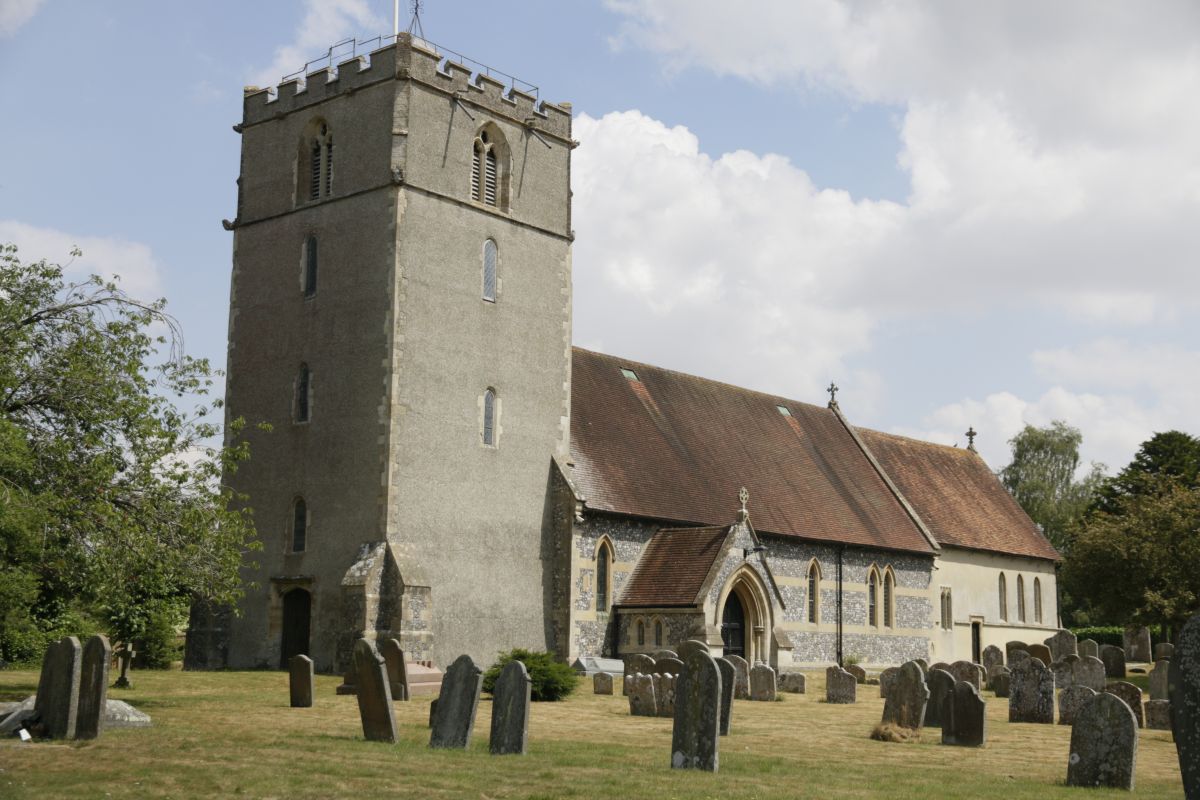
Now this church has been on my list to visit for a while and even more so after I found out about the wall paintings inside. Finally I managed to get along to visit the church.
Some history from Wikipedia
The earliest parts of the Church of England parish church of St Mary the Virgin date from the 13th century. It was begun by monks from the Abbey of Bec, an important Benedictine abbey in Normandy. There is a canonical sundial
on the south wall. The interior comprises a wide nave with two aisles
separated by transitional Norman arcades with carved capitals and a
chancel.
The church is thought to remain substantially as it was in 1500,
although some records state that there was a spire on top of the tower
until violent storm in 1727 blew it down. Jennifer Sherwood confirms
this and suggests that the "tower was probably remodelled during
repairs" at that time.
In the 14th century the chancel was decorated with a series of wall paintings showing a Tree of Jesse, the Last Judgement and the medieval legend of the Assumption of Mary.
Historians believe these wall-paintings were completed around 1320
possibly at the request of the de Barantyn family, who lived in one of
the two manors in Chalgrove at the time. Sherwood describe the paintings
as "one of the most complete series in the country" and suggest that they date from the mid 14th century.
The paintings were limewashed over at the time of the English Reformation and rediscovered in 1858 during renovation work commissioned by the then Vicar, Rev. Robert French Laurence.
Some of the paintings on the north wall are a little indistinct now due
to their age and two of the paintings on the south wall were covered or
damaged by marble monuments while the paintings lay hidden under the lime wash.
As well as medieval wall paintings and later stone monuments, St
Mary's has a highly unusual painted monument dating from the end of the
17th century. It was painted in or shortly after 1697 on the east wall of St James' chapel, which is in the north aisle of St Mary's. In 1984 it was expertly removed for restoration and repositioned at the east end of the nave. Its removal revealed a hitherto unknown medieval wall painting in St James' chapel, which is earlier than those in the chancel.
The west tower has a ring of six bells and there is also a sanctus bell. Henry II Knight of Reading cast the sanctus bell in 1659 and the second, third and fourth bells in 1664. Abraham II Rudhall of Gloucester cast the fifth and tenor bells in 1729. Henry I Bond and Sons of Burford cast the treble bell in 1888. The tower has also a single-handed turret clock, part of which was made about 1699.
St Mary's is a Grade I listed building.
St Mary's parish has long been linked with that of St Helen's Berrick Salome. In The Departed Village, Moreau writes "so far as records go back it [St Helen's] has never officially been more than a chapelry
of Chalgrove and since the Conquest the indications are that it has
never had a priest not shared with that parish. Such an arrangement is
the more surprising because Berrick and Chalgrove have had no common
boundary for the last thousand years", being separated by Berrick Prior (a part of Newington parish). "Moreover, while the incumbent has been only vicar of Chalgrove," "he is rector of Berrick."

The track leading to the church

St Mary as you walk along the path

Just about as much of a South view as you can have from across the churchyard

The belltower


Couple more views of the tower and one showing the one handed clock that dates back to 1699

The North aisle

Around to the East end and another view of the North asile

The East end

Small memorial garden by the South aisle

The Chancel cross on the east end

The entrance porch with is locked but the gate is glazed so you can see inside and view the wall paintings there


Some graffiti on the corner of the church and the other end of the church more letters can be seen

Couple of tombs near the West end of the church


Near the entrance to the churchyard which is on the left you can see an extension nearby shown above

Curving view of of the churchyard

Looking across to the North side

and one looking in a Westerly direction

The churchyard extension is the newer part where the recent burials take place

over in one corner is a Labyrinth

It is shaped like a shell

Though this hot weather and looking from the ground does not show it off that well. You can see it in Google Earth though


The carving on this headstone made me think he may have been a stonemason, nearby some of the older herastones

You can always find one which is overgrown and forgotten about

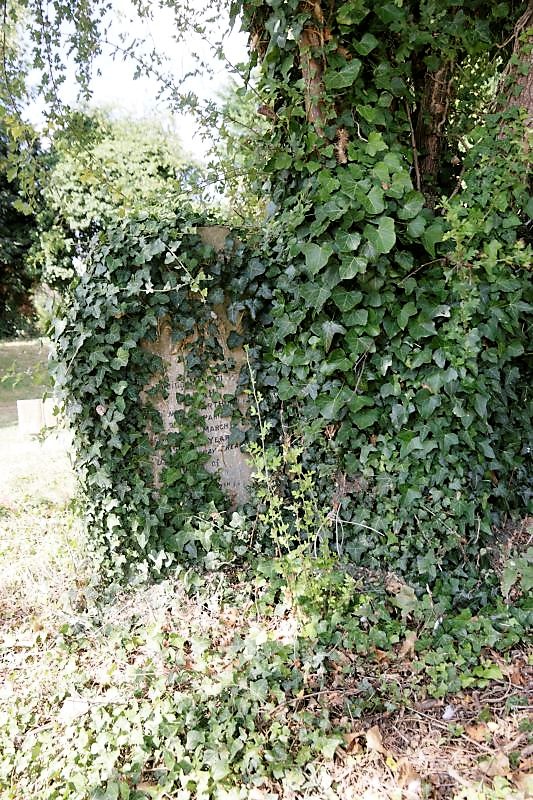

One headstone almost part of the tree with the ivy covering it. Right a pillar type monument


Looking East from near the extension

Have a wonderful weekend
See Part Two Here