Saturday, 3 October 2015

Highgate Cemetery Part 1


A few weeks ago it was my birthday and my wife gave me a card which she had made with photo's taken of me walking round a churchyard. Inside she wrote that the next day I was going to London and Highgate Cemetery for a guided Tour.  Awesome I could not wait.  I'm going to show some of the photos from the trip in two blogs. The first is the Old Cemetery which is only open by guided tour the second where you can walk around freely after paying to get in.
So I would advise you to get a cup of tea or coffee and cake if you like and enjoy my little tour of Highgate Cemetery West

 The entrance to the old part of Highgate cemetery
 
 The entrance gate which is locked, the sign says guided tours only


London Cemetery over the entrance


Across the road is the new cemetery


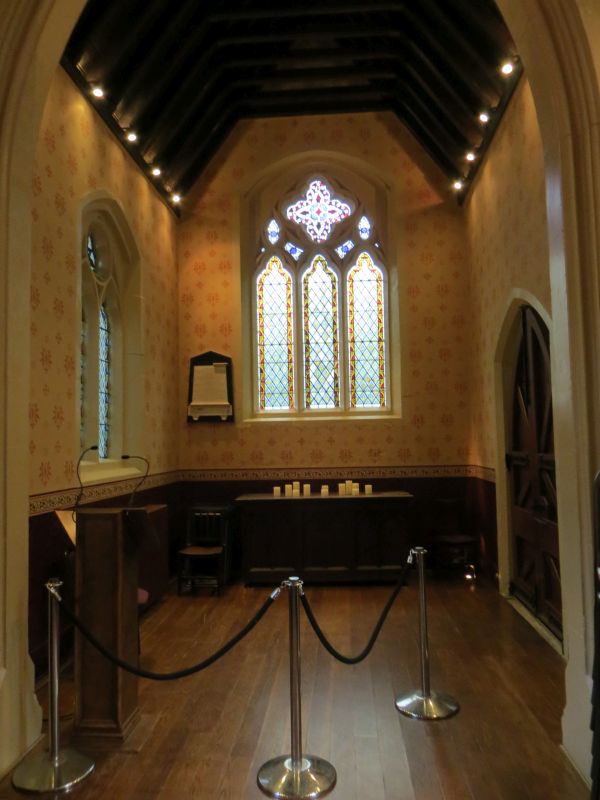
Once the gates are opened you meet in the chapel for the tour. There is a trapdoor beneath where I am stood which used to take coffins from this chapel via an underground tunnel to the other cemetery on hallowed ground because the Bishop of London consecrated the tunnel.


The ceiling in the chapel is quite ornate


Which has a few memorial on the walls


There are also stained glass windows to see as well


After being checking in we meet across from the entrance & chapel. There were two, one for the Anglican community  and another for the Dissenters. The Dissenters is one is now used as a office for the trust which owns the place now.

 Just across from where we stood was the Commonwealth war graves commission Cross  with a list of fallen on the plinth behind. There are also a few war graves dotted around the cemetery.


After climbing some steep steps you see the first of the cemetery


One of the first graves were shown was this one of a former coachman Jim Selby, he won a bet on driving a coach & horses from London to Brighton & back in Under 8 hours. He won. You can read about it in the blog I found


Not far away we passed the grave of Sir  Henry Knight Storks who  supported the nursing efforts of Florence Nightingale  The grave on the right is of David Wellesley Bell

 You can see the place is very over grown


The graves are close together with the odd vault. The one on the right is belonging to the family of General Sir Loftus Otway


You may remember a few years ago that Alexander Litvinenko was poisoned with  radionuclide polonium-210, well he is buried here on the left.


Where Looking round I was amazed by the place
 How it was laid out and the amount of foliage around


The cemetery opened in 1839, as part of a plan to provide seven large, modern cemeteries, known as the "Magnificent Seven", around the outside of central London. and the first person buried here a few days later was Elizabeth Jackson of Little Windmill Street, Soho, on 26 May


There are some wonderful memorials around like the Angel and the Lion which is on the tomb of George Wombwell the Lion his favorite Nero

The tomb of Thomas Sayers the bare-knuckle prize fighter. The dog  which guards the grave is a mastiff called Lion and was chief mourner at his funeral because he said it loved him more than his wife who was estranged from him and living with another man. 10,000 people lined the streets to watch the procession go by.


I'm told this grave with the horse is in the dissenters side and belongs to Queen Victoria's hose slaughter. It's thought that was made up and was just for show 


Lots of angels in evidence as you walk around in various poses. We were told the meanings of them but I forgot what they were.

This wonderful entrance takes you to more family vaults along what is called Egyptian Avenue


you access  along this old tunnel which has had the roof removed. They all have an Egyptian theme to them
Which carries on till you reach the circle of Lebanon . An ancient cedar tree was here long before the cemetery, and a circle of tombs was built around it


You can walk round the inside


One of them is where you can have your ashes stored and there is room for around 900 caskets, it was not popular and there are still spaces if you are interested. The vault on the right is is that of Radcliffe Hall and her lover

Round one side you come to these family vaults, we were taken through the one on the right to see the burials in there of people who paid to be place in it. A few were open ad you could see some wonderful decorated coffins. Unfortunately we were not allowed to take photos in that part.

 This was another vault we saw but could not go in but the photos we were shown left you in awe.
check out the  Vault of Julius Beer


Two of the headstones in Highate Cemetery

Norman Denzil Warne who is listed on here was the finance of Beatrix Potter  but died while she was away and buried  before she returned for the funeral. She visited once and after seeing the cemetery and how depressing the place was never returned


Some of the amazing tombs you can see as you walk along the paths


The odd one covered in thick ivy vines
Looks like something you see in a horror film creeping towards you


I liked the headstone on the left how it was like a tree trunk. The headstone on the right is that of Christina Rossetti Her Brother  Gabriel Rossetti Who founded the  Pre-Raphaelite Brotherhood, is buried there as well

There were a few  Pre-Raphaelite's buried nearby

I saw one Commonwealth War Grave, that of Sapper G.A. Brown Royal Engineers, 30th January 1915


On the last part of our tour we passed these vaults as couple of which were only a few years old, must have cost a  fortune to have one built


Just be for we returned to the start point we passed these two headstones. One is Philip Harben a celebrity chief I remember seeing on TV and Patrick Wymark  who was an actor I remember seeing on TV and film. Ironically he was in a film called Blood on Satins Claw which was filmed in Old Bix |Church near Henley which I have also written a blog on


I'll leave you with this beautiful sleeping Angel who was only discovered after the ivy was pulled back. She lasted all though years till a few weeks ago when a branch fell and broke the tip of her wing. You will be glad to learn she will be restored.
You can visit the second Blog on Highgate Cemetery here
Have a Wonderful Weekend


Saturday, 26 September 2015

St Peter's Llanbedr


Often referred to as Llanbedr Painscastle the church sits in a large churchyard and dates back to medieval times, the nave is thought to be 14th century but only a couple of things survive that date   from the middle ages. In 1818 the church was described as having a tower with three bells but in 1872 Kilvert described it as being a ruin. It was restored in 1879 by J. Evins of Hereford, at the expense of Captain Mynors and the people of the parish. I came across the sign for the church when on a visit to Paincastle so took the oppertunity to visit after going to St Tielo's


The low wall and gate leading to the churchyard. The church seems a long way  from the gate


Getting near to the church you find a lot of the more recent burials in the churchyard


further up you glimpse the South side and porch


the East end has a memorial on the wall and a small lancet window up high


Going round the North side shows the Chancel and nave


and walking further up to the West you see the two remaining bells
The South side is the more picturesque with the porch and churchayrd


The porch has a gate which is most likely there to keep out animals like sheep that you see grazing in the odd churchyard.


Inside we see a light and airy nave leading to a small chancel arch
Nearby is the 14th century font


Near the front of the nave is a table with the parish roll on it showing the births & deaths, might add one is quit eold

The wooden pulpit which  has steps leading to it

Here we look along the nave from the pulpit


Inside the chancel looking at the Altar which also has a Barrel roof like St Teilo's


Looking back through the nave from the chancel arch
 The altar with paneled back


Looking round the chancel there are quite a few memorials on the wall


Most of them date to the 1800's and a few around 1700's


Most you can read quit easy


though one is quite hard to make out
I noticed the edge of this grave poking out from under the carpet and when I lifted it found this wonderful old tomb slab


The choir stalls are quite simple and unadorned with elaborate carvings 
and either side of the altar rails are these beautiful kneelers depicting wildlife you can see.


This wonderful old organ is hidden under a cover opposite the newer electric one I did not bother with


One of the windows casting light on the altar


Go outside again and you can see this wonderful lantern


  On the South side wall are a couple of old memorials now unreadable


Nearby are a few small chest tombs


Looking towards the west you can see many old heastones


Over in the corner is a yew


The chest tomes vary in how they are made, being block, stone or slabs


Looking east another yew can be seen
Coffin shaped tomb slabs can be seen by this memorial


Another view of the yew at the West end


Near the porch you can see these two headstones with a sign pointing to a grave


This one which stands out
To Rev John Price MA. I'll leave you to read the story below the next photo


The wording on the gravestone plaque does not hint at the life commemorated here. It just states some basic facts that do nothing to reflect the reality of this man's devotion to his calling.
John Price was not an English gentleman, as were the vast majority of his peers in the Church of England in his lifetime, but was of farming stock from rural upland Carmarthenshire. He was an extremely bright youngster and graduated in Classics (Latin, Ancient Greek and philosophy I believe) from Queens College, Cambridge. He was ordained and placed in Lancashire by the Church until coming to a vacant living here in 1859.
His coming here was to lead to him gradually becoming known as 'the Solitary of Llanbedr Painscastle'. The church building was in a partly ruined state and without a congregation. Price's role was to develop one. However, maybe like many highly intelligent individuals he was possibly not best equipped to achieve this. Most of the upland farmers, farm laborers and their families were nominally at least Non-conformist or Dissenters or staunch Methodists, Baptists and would have been very reluctant to attend church, preferring chapel preaching, practices and religious opinions.
So Price could only afford to take the most basic accommodation for himself, despite some private income, and fell to resorting to paying his 'congregation' firstly sixpence a head to attend his services and later twopence. The result was that a large number of 'gentlemen of the road' would attend his church, along with a few n'er-do-wells, scoffers and drunks. Price even offered to marry pairs of vagrants who were 'attached' or 'living in sin' on the road as couples, paying them five shillings as an incentive. With poor eyesight and a failing grip on reality apparently he married several couples a few times each. He even provided oil-fired heaters in the colder winter months in the church and permitted tramps and hobo's to cook their dinners during his services.
Over the thirty years of his ministry here John Price sunk into an isolated, neglected state and his physical health suffered too. His generous, caring and unworldly outlook led to his being taken advantage of by travelers and the Church.
He was forced to resort to living in three bathing huts obtained from Aberystwyth, which were subsequently burgled by a vagrant and the huts were shortly afterwards burned, forcing Price to live in an upland hut little more than a chicken shed.
As an aging man he fell into his fire when asleep and was badly burned and by the time he reached his eighties had to be taken to Talgarth hospital where his clothes had to be scissored off his body and he was bathed, which resulted in his death, such was the trauma.
Eccentric he almost certainly was, but he never complained and served his ministry with devotion, comforting dying parishioners and performing his duties as best he could, despite being placed in quite the wrong locality and seemingly overlooked by his Church of England seniors and peers in a way that possibly contributed to his slow downfall.


Thanks for taking the time to visit and have a Peaceful Sunday