Woodcote is a small village over looking the Thames Valley one side of the Goring Gap. The A4074 passes beside it. The village I feel is a bit isolated being the main road passes it by so is popular as a place to live. The Church had been on my list to visit for a while and I finally got around to doing so when I found that it belonged to a group of churches I had started to visit so it seemed the right thing to do and finish of what I stareted. The History is from Wikipida
"By 1406 the parish of St. Andrew, South Stoke had at Woodcote a dependent chapel that served both Woodcote and Exlade Street. The chapel was dedicated to St. Leonard and there is a record from 1467 of John Chedworth, Bishop of Lincoln, issuing a licence for services at it. Architectural evidence suggests that the chapel, which had an apsidal chancel, was much older and probably dated from the 12th century.
The people of Woodcote and Exlade Street could not afford to pay a priest to serve at the chapel, and in 1597 it was recorded that the vicar of South Stoke held services at St. Leonard's only on Christmas Day, Easter Day and a few other days each year. Some worshippers travelled 3 miles (4.8 km) each way to South Stoke to go to church, but most preferred to travel less than 1 mile (1.6 km) to SS Peter and Paul in the adjacent parish of Checkendon. The law obliged everyone to worship in their own parishes, so since 1595 the Rector of Checkendon had prosecuted people from Exlade Street and Checkendon in the local archdeacon's court for coming to his church. In response the faithful of Exlade Street and Woodcote petitioned John Whitgift, Archbishop of Canterbury for permission to worship at Checkendon. Whitgift granted the request, so long as they continued to attend their parish church in South Stoke four times a year.[In 1653 the faithful of Woodcote and Exlade Street petitioned for St. Leonard's to be made a separate parish, but their request was not granted.
In 1845-46 St. Leonard's was rebuilt to the designs of the Gothic Revival architect H.J. Underwood. Of the original building little survives except the outer flintwork of the chancel walls.
St. Leonard's parish is now a member of The Langtree Team Ministry: a Church of England benefice that includes also the parishes of Checkendon, Ipsden, North Stoke, Stoke Row and Whitchurch-on-Thames."


A notice bioard and Church Sign greet youu at the gate

Looking at the South side of the church, the churchyard you can seen is neatly cut


Above the West end of the church with the bells and the North side of the church

Going around to the East end and the apse end

around to the South side

going back to the West end and view to the porch


Above the chancel cross one on the nave and another on the bells.
On the left & right the porch and entrance door

Inside you get a great view of the nave looking to the chancel

The chancel with the apse at the altar end


Above the altar with the three stained glass windows letting light it. To the right & left are the side windows


Above the central window showing Christ while Right and left a stained glass window of the Madonna & Child

The walls around the Chancel and apse are painted as well


Looking back out in the nave you can see a choir loft while nearby on the right the Pulpit


Above the view from the pulpit which is quite tall. On the right the church organ you will find at the back of the church

Above the font with One Baptism painted on it


Well as the loft was open I took the opportunity to get a couple of photos from it. The Nave, Chancel arch and altar

Around the windows in the loft you can see verses painted

Along with one that was not easy to get a photo of at he back of the loft


Outside some of the family tombs near the path leading to the church. The bird bath beside the porch made me think it was the original font but the stem looks like an old concrete pipe

At the West end of the churchyard is this garden of remembrance

Walk further around and you can see the newer headstones


Though you will find older ones forgotten about and the odd wooden cross

The grass here was recently cut as well


Above the grave of Gunner E.W.Pearson who died 10th March 1919. Nearby the headstone of of I presume his mother & Father.

I was taken with the Praying Angel you see here. I liked the life like features


By the church another forgotten memorial


Above another small angel with a cross behind. To the left some of the churhcyard still in use

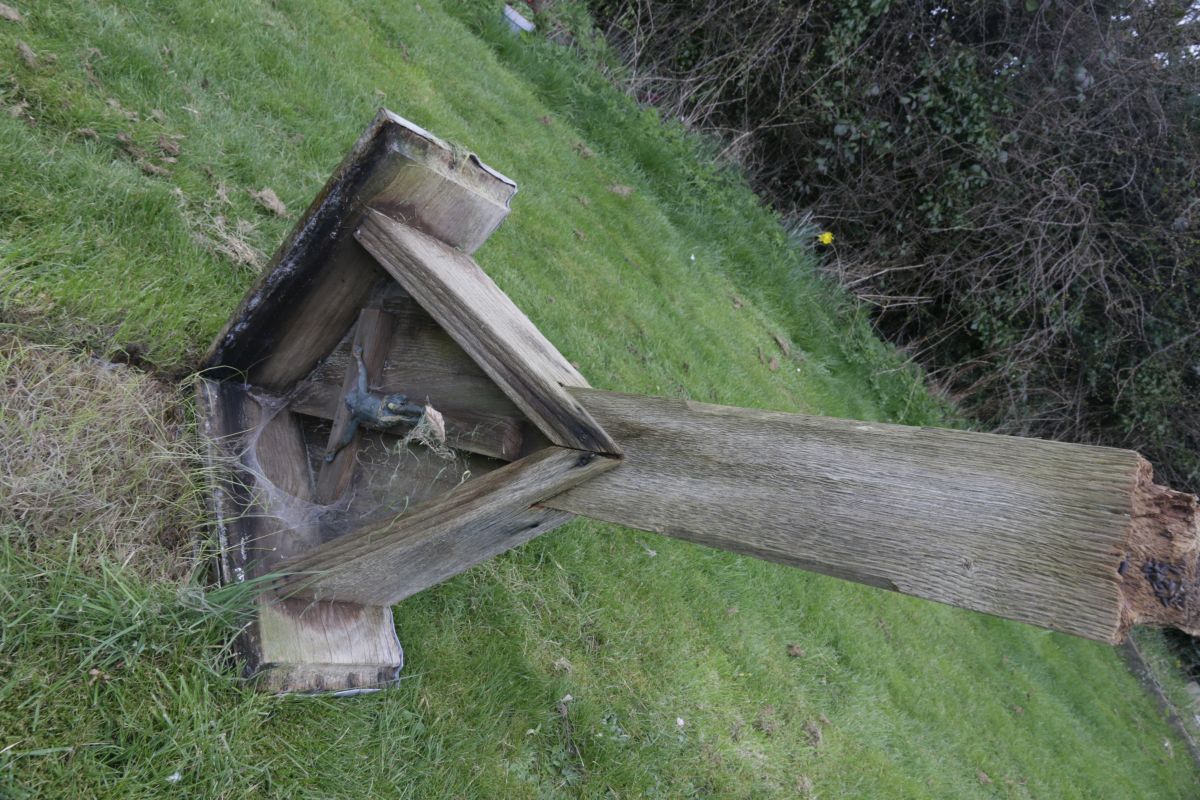
This wooden cross succumbed to the rot either falling over or placed down. I turned it over to get a shot of the front. It needs repairing but I fear on day it will just be discarded

Mixture of new and old graves


Above an older grave with a more up to date one in the background
To the right you can see part of the east end churchyard that was overgrown and clared

Some of the tombs in there are still forgotten about

while many of the old headstones are seeing the light of day again

These have yet to be uncovered

Like this tomb

A final look at part of the churchyard

and a photo of the good Shepherd I took in the church

I will leave you this week with a view across the churchyard to St Leonard's Church
Have a wonderful Weekend


